
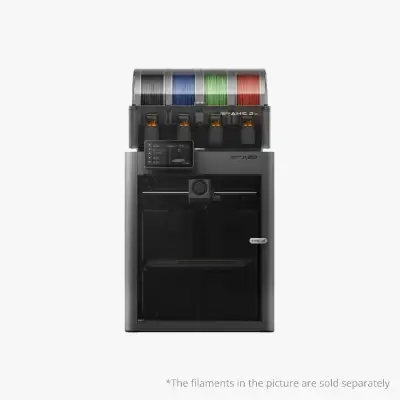
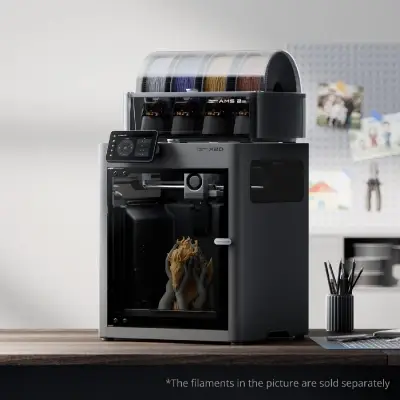
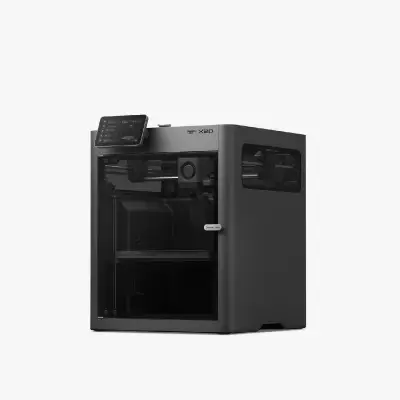
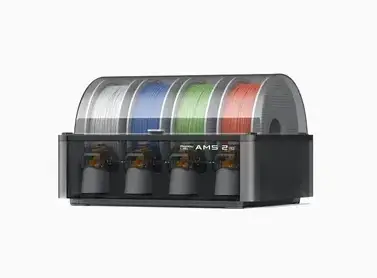
Buy Bambu Lab X2D AMS Combo 3D Printer
Buy Bambu Lab X2D AMS Combo 3D Printer- The Honest 2026 Buyer’s Guide
Buying the Bambu Lab X2D AMS Combo 3D Printer Starts Here:
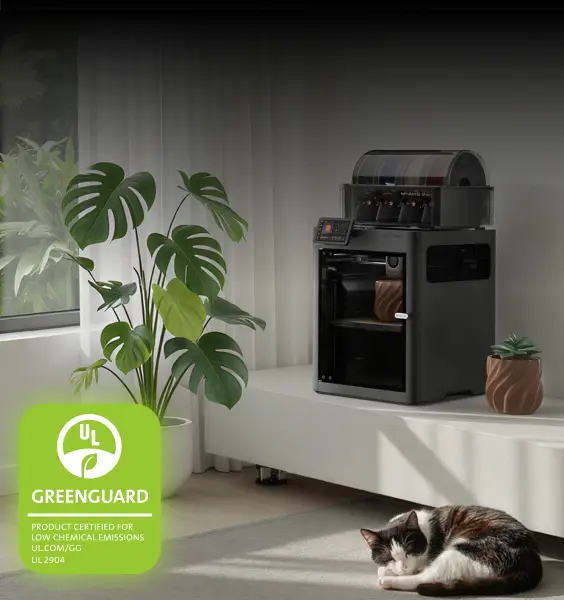
The X2D dropped on April 14, 2026 and the 3D printing community spent the next week in mild shock, not about the printer itself, but about what Bambu charged for it.
$649. For a fully enclosed, dual-nozzle, actively heated CoreXY machine.
Most people had the Combo pegged at $1,000+. Buy Bambu Lab X2D AMS Combo 3D Printer Bambu came in at $899 with the AMS 2 Pro included. Tom’s 3D called it Bambu “just flexing.” That’s about right.
The X2D is the direct replacement for the X1 Carbon, which Bambu quietly discontinued on March 31, 2026 after nearly four years as the benchmark desktop FDM printer. Buy Bambu Lab X2D AMS Combo 3D Printer.
There was a gap in the lineup, nothing between the P2S and the enormous H2D at $1,899, and the X2D fills it with something the X1C never had: a second nozzle built directly into the toolhead.
This guide is for anyone ready to Buy Bambu Lab X2D AMS Combo 3D Printer and wants a straight answer on which version makes sense for their setup.
What the X2D Actually Is (Without the Marketing Language)
The name breaks down simply. X means it’s in Bambu’s high-end compact line, the same family as the X1 Carbon. Buy Bambu Lab X2D AMS Combo 3D Printer. The 2 means second-generation internals, the X2D runs on the same refined platform as the P2S. The D stands for dual extrusion, which is new for this size of Bambu machine.
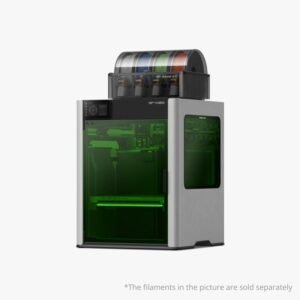
In practice, that means two nozzles in a single toolhead sharing one X-carriage. The left nozzle is a proper direct-drive extruder, the same type that handles TPU and abrasive filaments on every serious Bambu machine.
Buy Bambu Lab X2D AMS Combo 3D Printer. The right nozzle is Bowden-fed, which is a deliberate design choice and yes, a deliberate compromise. Bowden setups are less precise at speed and can’t handle flexibles.
Bambu capped it at 200mm/s and calls it the auxiliary hotend, which is accurate, it’s there for support material (PVA, PETG over PLA) or a second color, not for running fast carbon-fiber prints.
The way the two nozzles stay out of each other’s way is clever. When one isn’t printing, a small motor lifts it off the print plane. Buy Bambu Lab X2D AMS Combo 3D Printer.
A wiper cleans it before it comes back down. That solves the ooze problem that has plagued basically every dual-nozzle printer ever made, and Bambu ran the mechanism through over a million switch cycles before shipping. It holds up.
The chamber actively heats to 65°C and holds it evenly. That’s significant if you print ABS, ASA, or nylon regularly, materials that warp or delaminate without consistent ambient heat. The build volume is 256×256×260mm, same footprint as the X1C, which means it fits on the same shelf and doesn’t dominate the room the way the H2D does.
X2D vs X2D Combo: Here’s What the $250 Difference Buys You
The base X2D at $649 / €629 ships without an AMS. You get both nozzles. You can side-load two spools, one per nozzle, and do genuine dual-material prints: PVA supports that dissolve in water, PETG breakaway supports over PLA, two-color prints where each nozzle handles one material throughout the job. Buy Bambu Lab X2D AMS Combo 3D Printer. That already covers the use case most people buy a dual-extruder printer for.
What you don’t get is automation. No automatic filament switching, no multi-color beyond two materials, no hands-free spool management. If you print functional parts where dual material means cleaner support interfaces, and that’s a huge chunk of the desktop engineering market, the base version is completely sufficient.
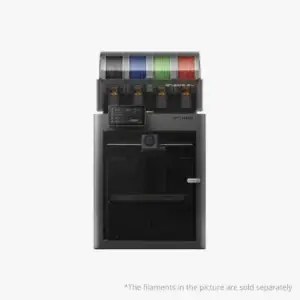
The Combo at $899 / €849 adds the AMS 2 Pro. One AMS unit handles up to six filaments automatically. Add more AMS units and you’re into serious multi-color territory, prints with six or eight color regions switching filaments hundreds of times without you touching anything. Buy Bambu Lab X2D AMS Combo 3D Printer.
The AMS 2 Pro retails on its own for around $249, so buying the Combo versus the base plus a separate AMS later is essentially a wash financially. The Combo just gets it all in one box.
Here’s the honest take: most people who buy a machine at this level coming from a P1S, X1C, or similar, are going to want the Combo. The AMS is what separates a multi-material printer from a printer that happens to have two nozzles.
Buy Bambu Lab X2D AMS Combo 3D Printer. If you already know you want automated color switching, don’t buy the base to save $250 and then order the AMS three months later at full price.
The one case where the base makes real sense is if you print mostly engineering materials and your primary use for the second nozzle is dissolving PVA supports. Two spools, two nozzles, no automation needed, and you save $250 upfront.
The Specs That Actually Matter
Build volume is 256×256×260mm. The toolhead hits 1,000mm/s. The auxiliary Bowden hotend is capped at 200mm/s. Nozzles go to 300°C, the bed to 120°C, the chamber to 65°C. It runs below 50dB in Silent Mode, quiet enough to print overnight in a home office without bothering anyone.
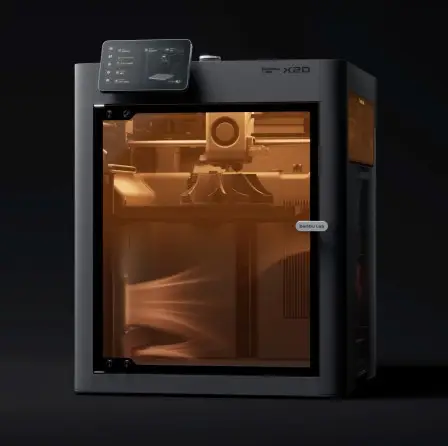
The material list is broad: PLA, PETG, ABS, ASA, TPU (left nozzle only), PA, PC, PVA, PLA-CF, PETG-CF. Carbon fiber variants work because the left nozzle is direct-drive and can run hardened nozzles. Buy Bambu Lab X2D AMS Combo 3D Printer. The X2D ships with a textured PEI flexible steel plate, which handles most of those materials without needing glue or extra surface prep.
One feature worth understanding before you buy: Flow Dynamics Calibration. Most printers use one static K-factor for extrusion and apply it universally. The X2D builds a dynamic model of your extrusion system, accounting for nozzle wear over time, filament moisture, minor residue buildup, and adjusts in real time.
Buy Bambu Lab X2D AMS Combo 3D Printer. On long multi-hour prints, that’s the difference between consistent surface quality across the entire job and a print that starts well and subtly degrades toward the end.
There’s also an optional Vision Encoder add-on sold separately. It compensates for belt stretch and mechanical drift over time, maintaining 50-micron positional accuracy. Buy Bambu Lab X2D AMS Combo 3D Printer. Most users won’t need it day one, but for large, tight-tolerance functional parts it becomes meaningful after months of heavy use.
Pricing by Region
In the US, the base is $649 and the Combo is $899. EU buyers pay €629 and €849. UK pricing is £569 and £769.
To give those numbers context: the X2D Combo is cheaper than the Prusa Core One, cheaper than the Creality K2 Plus, cheaper than the Snapmaker U1, and nearly $1,000 less than the H2D, while having dual extrusion and an active heated chamber that most of those machines don’t offer at any price. Buy Bambu Lab X2D AMS Combo 3D Printer. It’s not an exaggeration to say this is the most aggressive price-to-spec ratio in Bambu’s entire history.
Who Should Actually Buy This
If you’re upgrading from a P1S, P2S, or X1 Carbon and multi-material printing is the main reason you’re looking, whether for clean soluble supports or multi-color models, the X2D is the obvious next machine.
Buy Bambu Lab X2D AMS Combo 3D Printer. It’s what the X1C should have become: same compact form factor, same reliable Bambu experience, but with a second nozzle and a chamber that actually holds temperature for engineering materials.
If this would be your first Bambu printer, the X2D is probably not where you should start. The A1 Mini or a base P2S gets you into the ecosystem at a lower cost and with a more forgiving learning curve. Buy Bambu Lab X2D AMS Combo 3D Printer. The X2D assumes you already know your way around Bambu Studio and have a clear reason for dual-extrusion capability.
If you own an X1C that’s working fine and you print single-material PLA or PETG, there’s no urgent reason to upgrade. Bambu is supporting the X1C with firmware through May 2027 and spare parts through March 2031. Buy Bambu Lab X2D AMS Combo 3D Printer. Your machine isn’t being abandoned, it just isn’t getting the new hardware.
And if you need a build volume larger than 256mm in any dimension, the X2D won’t solve that. The H2D is the next step up, and it’s a fundamentally different machine at a fundamentally different price.
X2D vs X1 Carbon: Worth Upgrading?
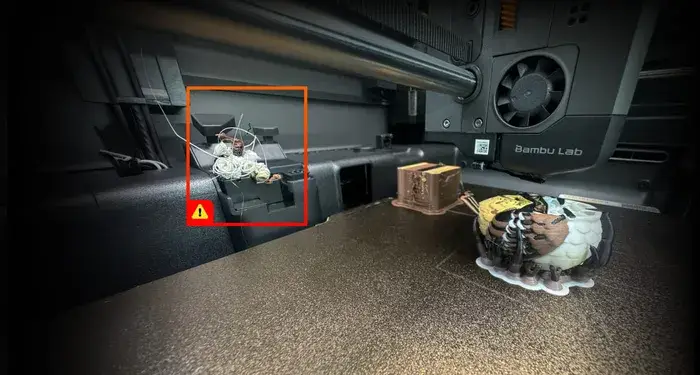
The X2D is a better machine in nearly every dimension that matters for multi-material work. It has the second nozzle the X1C never had, a chamber that runs hotter and more evenly, the same familiar Bambu ecosystem, and it costs less than the X1C Combo did at launch.
The X1C was retired because the P2S caught up to most of what made it compelling at a lower price point. The X2D is the answer to what the X1C couldn’t do: two materials, clean support interfaces, automated multi-color through AMS without the waste penalties of single-nozzle filament switching.
If you bought an X1C specifically for multi-material work and found yourself frustrated by AMS waste towers and long purge sequences, the X2D’s second nozzle changes that workflow in a real way.
X2D vs H2D: When It’s Not the Same Conversation
These two machines solve similar problems at completely different scales and price points.
The H2D uses true IDEX, two independent carriages, each with a full direct-drive extruder, that can operate simultaneously. It’s a larger footprint, starts at $1,899, and is built for shops that need maximum throughput.
Buy Bambu Lab X2D AMS Combo 3D Printer. The X2D has two nozzles on one shared carriage with a Bowden auxiliary. The tradeoffs are real: you can’t run both nozzles simultaneously, and the aux hotend has speed limitations the H2D doesn’t.
But for most desktop studio users, the X2D gives around 80% of the dual-extrusion benefit at about a third of the price. Unless you specifically need IDEX for mirror or duplication mode, or need more build volume than 256mm offers, the H2D is overkill for the vast majority of makers.

Where to Buy the Bambu Lab X2D and Combo
The most direct route is Bambu Lab’s store at bambulab.com. US orders ship from their US warehouse within 1–3 business days. EU buyers get EU warehouse shipping, which matters for customs, voltage compliance, and warranty claims.
Buy Bambu Lab X2D AMS Combo 3D Printer. Buy Bambu Lab X2D AMS Combo 3D Printer. Best Buy carries the Combo in the US at $899.99, and Microcenter has it in select locations for same-day pickup.
For EU and UK buyers, going through an authorized reseller handles local warranty support and gives you VAT-inclusive pricing from the start, which matters if you ever need to claim warranty service without shipping a 16kg machine back internationally.
Quick Answers Before You Order
Can I add an AMS to the base X2D later? Yes, and the X2D supports AMS 2 Pro, AMS Lite, and AMS HT. Connecting more than two AMS units requires a 4-in-1 PTFE Adapter (FAZ013-N). Buy Bambu Lab X2D AMS Combo 3D Printer. That said, buying the Combo upfront saves money over buying the base and AMS separately.
Can it print TPU? Yes, through the left direct-drive nozzle only. Don’t run TPU through the right Bowden hotend.
Is the Vision Encoder included? No. It’s a separate purchase, and most users won’t need it right away.
Can I use OrcaSlicer? Yes, it’s officially supported. Bambu Studio gets new features earlier, usually 6–12 months ahead, but OrcaSlicer works well from day one.
Does it come with a print surface? Yes. Both configurations ship with the flexible textured PEI steel plate.
Long story short
The Bambu Lab X2D is the best value dual-extrusion desktop printer available right now. At $649 base and $899 for the Combo with AMS 2 Pro, Bambu priced it to make the competition look slow and expensive, and the early reviews from TechRadar and Tom’s 3D after extended testing back that up.
Buy the base if dual-material support printing is your primary goal and you don’t need automated color switching. Buy Bambu Lab X2D AMS Combo 3D Printer. Buy the Combo if you want the full multi-color workflow and want everything in one box. Either way, you’re getting hardware that was genuinely out of reach at this price six months ago.
Last updated July 2026. Prices verified at time of publication.*
Reviews
There are no reviews yet.